Saturday, July 4, 2020

Common sense

In last week's blog I made the claim that common sense tends to be rightward leaning. This caused some comments with some readers taking exception to the implication that common sense is, by definition, right-wing.
The point I was trying to make was that we cannot rely on "common sense" to solve any political issues. But, I suppose, in using common-sense as a throwaway phrase in the way I did I opened myself up to criticism. Indeed, the whole notion of common sense is so ubiquitous that the fact that there is such a thing seems to be, well, common sense.
If you look up common sense in a dictionary you are likely to find it defined in the following way:
“the basic level of practical knowledge and judgment that we all need to help us live in a reasonable and safe way”
Which tells us very little. However, it does point to one important facet of “common sense” and that is its contextual nature. If it concerns “practical knowledge” that we “need to help us live”, then it suggests that in different societies common sense is going to mean different things. Which suggests that the whole notion of common sense is socially constructed.
Why does it matter? From a political perspective it matters because common sense represents not just a sense of the right way to live in order to survive but the right way to live in terms of social justice. The right-wing think-tank British Futures published a blog in 2013 in which they started with the following assertion concerning good citizenship:
“Obey the law, learn the language, play by the rules and contribute positively to British society.”
They went on to describe the evidence from their own focus groups on integration in which these ideas “were all seen as obvious and common-sense requirements, in the realm of personal behaviour. This reflects a robust and widely held sense of what many people think of as pretty self-evident common-sense foundations for integration.”
The fact is they are right. Many ordinary citizens would agree with these notions without too much pause for thought. Many on the left would, of course, see these common-sense notions for what they are: not a recipe for integration but for assimilation in which a mono-English culture imposes itself on all other cultures with which it comes into contact. 
Common sense tends to be an appeal to what could be thought of as a mob instinct, so that in 2010 when then Tory Prime Minister David Cameron wanted to rid his business friends of the iniquities of health and safety legislation he appointed his friend Lord Young to write a report which he titled, interestingly enough, “Common Sense, Common Safety”. The report makes a number of claims, amongst them this:
“We should all accept that health and safety in non-hazardous occupations is little more than common sense in action.”
In other words, we do not need legislation to protect workers just “common sense”. It is this common sense that led to the workplace deaths of 111 workers in 2019/20, and to over 69,000 workplace injuries resulting in 28.2 million days lost due to workplace illness and injury (according to the Health & Safety Executive). How many of us have worked in workplaces where somebody has been injured only to hear management declare that they would have been okay “if they had just used their common sense”. The result of which is to absolve management of any responsibility for the safety of those they employ.
Common sense is a favourite weapon of Conservatives and their allies in their cultural war against the working class. Rebecca Roberts writing on the Centre for Crime and Justice Studies website in 2011 noted that it, “offers a set of simplistic yet often misguided justifications for the existence and expansion of criminal justice.” She cites the example of Louise Casey, Commissioner for Victims and Witnesses, who giving evidence to a parliamentary committee argued ‘The evidence base is common sense, Chairman’ to which the Chair of the Justice Committee Sir Alan Beith retorted “There is common sense and there is evidence. They are not the same thing.” The point is that, according to Ms Roberts, common sense is used to propagate a series of, usually false, myths that have the collective outcome of increasing the policing of working-class communities. 
As I pointed out a few weeks ago in this blog the DWP, supported by the common-sense view that benefit fraud is both wrong and endemic employs eight times more people to investigate benefit fraud than HMRC employs to investigate tax evasion. Common sense is the justification used by Tory ministers to create the hostile environments for immigrants, for those on benefits, for trade unionists and for pretty much anybody with whom they disagree.
Does this mean that all common sense is, by definition, right wing? My friend Paul commenting on last week’s post made the following point:
“Common-sense is, at  least  in  part, acting  in  the   interests of  the  community  in  the   knowledge that  this  will  benefit  you  as  an  individual.. Ideas  like  the  NHS, the  welfare  state  and  free  education are  common  sense left  wing  ideas  which  are  supported  by the  vast  majority  of  people  in  the  UK.”
Of course, he is right. There is and always has been a strain of thought in this country, let’s call it socialism, that has had an appeal beyond the narrow confines of the left. In other words, common sense is not immutable, it can be challenged, and it can change. 
My friend Lee, also commenting on last week’s post, pre-empted my defence when he said:
“…the prevailing ideas in society are those of the ruling class, but ..ideas change on the basis of class struggle.”
What Lee is pointing to here is a passage from Marx from ‘The German Ideology’ where he discusses where ideas come from. The passage is worth repeating in full, not least because like so much of Marx it is so beautifully written.
“The ideas of the ruling class are in every epoch the ruling ideas, i.e. the class which is the ruling material force of society, is at the same time its ruling intellectual force. The class which has the means of material production at its disposal, has control at the same time over the means of mental production, so that thereby, generally speaking, the ideas of those who lack the means of mental production are subject to it.”
It is not difficult to see the point that Marx is making here. The class which controls the “means of material production” (by which he means the economy) also controls “the means of mental production” (by which he means not just the mass media, but also culture more generally). So, the dominant ideas (which include what we come to think of as common sense) dominate, and those who do not control, but do consume, the dominant culture, are subject to it. In other words, the dominant ideas, including common sense, are treated as universal, and those ideas come directly from the ruling class and are propagated by their control of the mass media and popular culture.
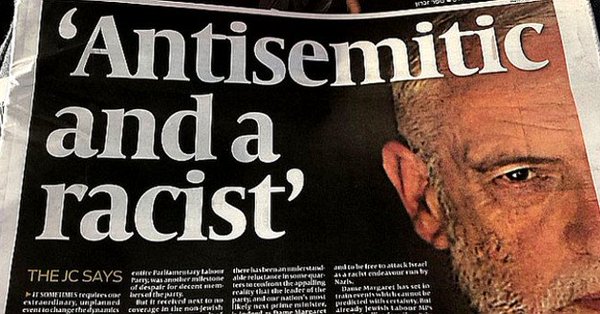
It is only necessary to look back to the last General Election, to see how true this analysis remains. How many left-wing Labour activists reported that on the doorsteps we were losing votes because of Jeremy Corbyn and, specifically, the accusations of anti-Semitism. Remember, the left had spent a good deal of effort repelling and debunking the anti-Semitism claims and also in counteracting the lies told about Jeremy Corbyn, mostly to little avail. It was a form of common-sense that held that Labour under Jeremy Corbyn was institutionally anti-Semitic and that Jeremy Corbyn was unfit to be Prime Minister, even when up against a serial liar unable to say how many children he had fathered.
These ideas about Jeremy Corbyn have been repeated ad nauseum since the election, particularly by his political enemies on the right-wing of Labour. The recent report from Labour Together makes the following point:
“In 2017, Jeremy Corbyn’s personal poll ratings dramatically improved over the campaign.  Had these levels been maintained, Labour’s vote share in 2019 would have been 6 points higher. The very low poll ratings on leadership going into the 2019 election cannot easily be disentangled from the handling of issues like Brexit, party disunity and anti-Semitism.”
What the report fails to mention is that the Conservatives were equally divided over Brexit, that there was little faith in many parts of the party for Boris Johnson and they were being criticised for their failure to act on accusations of Islamophobia led by Baroness Warsi. But, the crucial difference was that the mass media did not preface every mention of Boris Johnson with the fact that he is a serial liar, or every report on the Conservatives by reminding viewers, listeners and readers that the party was (still is) institutionally racist, with particularly high levels of Islamophobia at every level of the party.
The reason for this failure to hold the Conservatives to account in the same way is explained by the fact that the owners of all the major newspapers are Tory supporters, as are all the senior management of the main broadcast news organisations. But, in addition, years of propaganda favouring the Tories have had their effect. It is now common-sense knowledge that the Tories are more trustworthy with the economy than Labour, that the Tories are less divided than Labour and, of late, that Labour’s grassroots are a bunch of bullying racists (which ironically has always been a valid description of the Tory faithful).
This is why common-sense is rightward leaning. Despite pockets of left-wing sentiment (and for sure these exist) the average voter is subjected to a veritable tsunami of pro-establishment propaganda, resulting in their passive acceptance of the idea that some things are simply the result of natural forces over which they have no control. Lee (see above) is correct that when brought into direct contact with the ambiguities of modern capitalism people can be won to a view that common-sense is the problem not the answer. That indeed, all the things they have been brought up to believe are, on reflection, untrue. Anybody on the left will know how this works because unless they have been very fortunate, they will have undertaken this journey. I know I had to.
It is easy for people on the left to forget that the left are a minority in British politics. This side of the socialist revolution, to quote Tony Cliff of the Socialist Workers Party, the socialists are a minority. Does this mean, though, that we cannot possibly win? Is this the obvious conclusion from an analysis which accepts that we are swimming against the tide? 
Ted Grant
Both Carol and Tony thought that what I said last week was accurate but “depressing” and “really defeatist”. I certainly don’t set out to depress people or to sound defeatist, but I have always thought that false optimism is almost as bad as naïve pessimism. In one the revolution is always just around the corner. Ted Grant of Militant used to end his speeches with the news that the revolution was 5, 10, 15 years away. As a friend of mine once remarked ‘at least it is not getting further away’ though that was 35 years ago. But that kind of optimism is better than the pessimists I used to encounter who would tell me that ‘we tried that and it failed’ as if nothing could ever succeed. Being realistic involves accepting what we are up against, and that includes a widely accepted common sense which supports the established ruling class. But, it means also understanding that ideas actually matter. That people can be won over to ideas which make them question and abandon the common sense conceptions that they have been told are natural.
Common sense has no great value from a socialist perspective because it is presented as universal and the only rational way of seeing the World. Socialists cannot accept capitalist/bourgeouis ideas as somehow divorced from the social system that gave birth to them. Only in a socialist society can common sense be said to have a socialist flavour. 

As Marx concludes in ‘The German Ideology’:
“For each new class which puts itself in the place of one ruling before it, is compelled, merely in order to carry through its aim, to represent its interest as the common interest of all the members of society, that is, expressed in ideal form: it has to give its ideas the form of universality, and represent them as the only rational, universally valid ones.”
In capitalist society, the ruling class (the establishment if you like) dominates the production and reproduction of ideas, presenting ideas which support its continued dominance of economic, cultural and social life as merely common sense. The problem is that socialists in challenging those ideas tend to do so on the same grounds as Paul (see above) argued, mainly that there is a socialist common sense and therefore common sense does not have to be rightward leaning. In my view that is to totally misunderstand the role of ideas and how they are formed in capitalist societies. It is to assume that just because a minority have seen through the system, that we can claim to be the majority.
As socialists we cannot assume that the vast majority of people passively accept our ideas for we do not have control of the means of mental production to convince them. This should not be taken to mean that change is impossible. No society that has undergone a revolutionary change – France, Russia, China, America, Iran etc. – have done so based purely on ideas. It is material factors which drive revolutionary change. 
Yes, it would be nice to see a left-wing government in the UK, but would that bring about socialism? Capitalism will only allow a Labour government on condition that it does not challenge the social system itself. For socialists to pretend that they can harness common sense for the greater good within a capitalist system is, in my view, naïve. Common sense in a capitalist social system is capitalist supporting. At the point at which common sense becomes socialist we will be living in a socialist society where ideas such as equality, public service, justice will be able to find their true representations. That future may not appear to be within our grasp currently, but with the environmental catastrophe still looming and the Covid crisis some way from being resolved, capitalism as a system is under enormous strain. These could yet prove to be the conditions which herald a change of social system, as only socialism offers a realistic way of managing the earth’s resources and allowing the utmost freedom in a quickly changing landscape.

Sunday, June 28, 2020

End of the line for Labour’s left?


The sacking of Rebecca Long-Bailey as Shadow Education Secretary is the latest in a long line of attacks on the left in the UK by supporters of the Israel state. The battleground over support for Israel was a key part of the attacks on Jeremy Corbyn who was a little too keen on Palestinian rights for some both inside and outside the Labour Party. Allegations of anti-Semitism have dogged Labour since 2015 when, under Ed Miliband’s leadership, Labour openly declared their support for a two-state solution to the ongoing Israeli-Palestinian conflict. 

Rebecca Long-Bailey made the mistake of retweeting an interview with left wing actor Maxine Peake. The interview was far reaching  and at one point Ms. Peake made the following unguarded comment:
“Systemic racism is a global issue, The tactics used by the police in America, kneeling on George Floyd’s neck, that was learnt from seminars with Israeli secret services.”

This, apparently, is a Jewish conspiracy theory. But is it? First, it doesn’t mention Jews, but Israel. Second, it is very specific which Israeli’s – secret services. Nobody denies that Israel has a secret service, so is it a conspiracy theory to suggest they teach American police? The existence of exchanges between Israel and a number of police forces, including American, is well known, so what is in dispute here is the particular allegation about kneeling on a suspects neck.

Whether this was one of the tactics discussed is disputed, but what is not disputed is that American police have received training from the Israelis. Amnesty International have demanded that these are stopped. What is also not disputed is that Israeli soldiers routinely use a knee on the neck of Palestinians. Did the US police learn from the Israeli army or vice versa, or was some third party involved? These are the kind of forensic details that the current Labour leader is supposed to excel in. But, on this occasion there was no need for him to deploy his renowned forensic skills, for it was not the accuracy of the statement that was in dispute but it’s underlying intent. Maxine Peake, it turns out, was guilty of anti-semitism. And, by association, so was Rebecca Long-Bailey. In such circumstances, Sir Keir clearly had no choice. 
This accusation by a well known thespian and Labour supporter had caused such distress to Jewish people in the UK that he had no choice but to distance himself from accusations of having a backbone, sorry I mean of being soft on an anti-semitism, and no choice but to kick Rebecca Long- Bailey off his Shadow Front Bench.

Whether or not there was an underlying intent to cause distress to the so-called "Jewish community" is difficult to assess. Certainly Maxine Peake has not, as far as I can tell, exhibited anti-semitic tendencies in the past. Besides, the statement itself appears to be a criticism of the Israelis in training American police officers, rather than a statement intended to cause distress to a particular ethno-religious group. In as much as many Jewish people are distressed at any criticism of Israel it could be argued that such criticism is, by definition, anti-semitic. In essence, this has become the de facto position of the Labour leadership.

This is a major shift in the party's foreign policy and makes null and void the motion passed at last year's conference in support of Palestinian rights. The motion was accompanied by Palestinian flag waving which showed the depth of feeling this issue arouses amongst Labour activists.

The text of the motion begins by noting:
·       Recent actions by US and Israeli administrations are destroying prospects for peace in Palestine – by recognising Jerusalem as Israel’s capital, stopping funding UNRWA for Palestinian refugees, the continuing siege of Gaza, expanding illegal settlements and announcing plans to annex illegally large areas of land occupied in 1967.
The motion continued:
·       Labour’s ethical foreign policy must prioritise Palestinians’ rights to freedom, justice and equality, including by applying these principles based on international law to all UK trade with Israel.
Conference resolved to:
·       To oppose any proposed solution for Palestinians, including Trump’s ‘deal’, not based on international law and UN resolutions recognising their collective rights to self-determination and to return to their homes.
According to the Times of Israel this motion could be summed up as:

“UK Labour overwhelmingly backs anti-Israel agenda.”

And, herein lies the point. Maxine Peake and by extension, Rebecca Long-Bailey were not guilty of anti-Semitism, but of being critical of Israel. Criticism of Israel particularly where the Palestinians are concerned, is considered by the pro-Israel lobby as anti-Semitic. They are, so it is assumed, likely to cause distress to the "Jewish community " , as if all Jewish people belong to one homogenous whole, an undifferentiated view of a diverse group of people which it has always struck me as very close to being anti-Semitic itself.

So, what is Sir Keir playing at? Clearly this has little to do with anti-Semitism, and plenty to do with anti-leftism. This is the final nail in the coffin of the unity phase of the right-wing take over of UK Labour. Most of us never believed the right's calls for unity seeing them as code for "shut up and do as you're told!”, but since the ousting of Jeremy Corbyn it has been the background noise as the left have been marginalised.

The inclusion of Rebecca Long-Bailey in the Shadow Cabinet was seen by some as evidence that Sir Keir was sincere in his attempts to move beyond factionalism. In retrospect it probably told us more about RLB than Sir Keir. When every other left-winger was purged from any position in a Shadow Cabinet containing over half the Parliamentary party, it could only have been RLB's ego and ambition that allowed her to stay. Sir Keir was clearly just waiting for an opportunity to show the establishment, whose support he believes he needs in order to stand any chance of winning an election, that his leadership was a clear break from Jeremy Corbyn.
         
The sacking of RLB is not just a clearing out of a left-winger, it is a symbolic act aimed at the remaining left membership. It says, as clearly as if it was printed on a placard "You are not wanted here." By picking Israel as the defining issue Sir Keir has ensured that he has, through a single act, demonstrated his loyalty to a powerful and influential lobby and ensured the speeding up of a process by which the members who joined to support Jeremy Corbyn will leave. From the Starmer camp's perspective this was a win-win situation. Any backlash from the members could only play into the hands of the party's right who are anxious to rid the party of a membership who are not only to the left of them, but appear as a baying mob demanding mandatory reselection. If they were honest they would admit that anti-Semitism always has been and remains a minor problem in the Labour Party, but members demanding a democratic say in the party's policies remains anathema to a group of people who regard being an MP as an entitlement not a privilege.

So, is this the end for the left in the party? In many ways it has changed very little. No group of MPs is contemplating the possibility of leaving and setting up an alternative party. There is no grouping outside of the party capable of challenging the party electorally. So talk of leaving the party to form a new party of the left is just that - talk. I am not saying that people should stay in a party they do not feel comfortable remaining a part of. But, if anybody is under the illusion that a couple of hundred people can quit Labour and form an alternative they are in for a rude, and disappointing, awakening. Those who leave will either become part of a smaller grouping or remain unaligned. Neither are the end of the World, but they are some distance from the mass support the Labour Party still enjoys.
         
The truth is that the right now control every part of the Labour Party and the left can only remain to be an irritant. It is not just that Sir Keir’s Party will be pro-Israel, but more importantly enthusiastically pro- capitalism, and anti-trade union. The shift away from the social democratic policies of Jeremy Corbyn's era to neo-liberal Tory-lite policies which may well make Blairism appear communistic, is not likely to take long. Sir Keir is determined to win back voters he believes were lost by policies that were too left-wing, and by appealing to an establishment media that loathed Jeremy Corbyn on a personal, as well as political level.

Inside the party what is left of the left will have to exist in marginalised pockets that continue to argue for policies that redress the systematic inequalities that characterise British society. Whether we can win those arguments will be determined by factors external to the Labour Party. If, however, the left makes support for Palestinian rights the ultimate test of the party’s commitment to social justice we will find ourselves driven out. The losers will be both the Palestinian people who will lose any advocacy within the mainstream of British politics; and the poor and marginalised in British society who will continue to be acted on rather than acted with. Ultimately, in a polity that encourages a passive apoliticism the left is still a minority. Not because the right is actually a majority, though they do control the media and most of the economy, but because “common sense” tends to be right wing leaning. Factional battles in the Labour Party may seem a long way from the sacking of a Shadow Cabinet Minister, but in truth that is the deeper meaning of the faux outrage over a throw away comment by an actor in an interview in The Independent.

Tuesday, June 16, 2020

BLM and socialism


The murder of George Floyd by a Minneapolis police officer has sparked a huge global protest. But, his murder was symbolic not because it was an unusual display of police brutality but rather because it summed up in extreme form the daily lives of so many black and minority ethnic citizens in countries throughout the World. The fact that the murder was captured on video made any denial entirely implausible. Yet, on Sky News this week a member of the white British commentariat, discussing the Black Lives Matter protests in London, claimed that the police were being prevented from doing their jobs by an over-sensitivity to accusations of police brutality. Anti-racism protestors are described as "thugs" by the American President, as "law breakers" by the British Home Secretary (herself Asian), and as "unreasonable "by the Leader of the British opposition party. All of them miss the point. A point missing exercise supported by the main news outlets in the UK whose focus on the protest was almost entirely from a public order perspective and whose commentary was dominated by policing specialists and white journalists and academics.

For a short time the media was sympathetic to the protesters. But, this was on condition that they behaved "responsibly", had their march and then returned home satisfied that they had made their point. Without violence most of the media would have given little coverage to the demos taking place and would quickly have moved on. But whilst the media are attracted to violence like a baying mob, they can also feign indignation and moral repugnance. Sky News coverage was almost exclusively from behind police lines and the reporter kept reminding viewers that the message of the protests (which I noticed he did not keep repeating) would be lost. The violence was the actions of a minority who had turned up intent on causing trouble. The police, we were told, had sympathy with the protesters but had no choice but to respond to this irresponsible minority. And, the evidence as if the constant commentary was not enough was a police horse so terrified of the protesters that it bolted causing its rider to hit a traffic light and be knocked to the ground.

I have been on numerous demonstrations across the years and on most occasions they are good natured without any hint of violence. Perhaps the small minority of trouble makers stayed away from those events. Where there has been trouble it has invariably been caused by over- aggressive policing. Often, the police cordon off areas to prevent protesters from going near them. The inevitable consequence of which is to create a confrontation with people who think they have a right to walk down public streets and a right to demonstrate. I have been on a couple of demos where police horses are deployed. It's terrifying. I am over six foot and they tower over me. The only viable option for protesters is to get out of their way. They are extremely well trained and used to being surrounded by crowds. If a horse was terrified, and if their rider lost control it is highly unlikely that the crowd could have caused it. Either the horse was inadequately trained or the rider was, but either way that is the responsibility of the police not the protesters.

To see genuine anti-police violence it was only necessary to await the arrival of the “patriots” who, egged on by Boris Johnson, turned up to “protect” Winston Churchill’s statue. This they did by getting drunk, urinating on a monument to PC Keith Palmer, giving Nazi salutes, terrorising people having a picnic, racially abusing any passing black person and fighting with the police. That even the Daily Mail condemned them is all the evidence needed of how odious they were.
But that the attitudes they espoused were straight from many a Mail front page or editorial went without comment as the media sought to create an equivalence between a bunch of racist thugs and anti-racist protesters.

But, I am falling into the trap the media have set. Instead of talking about why the protests occurred, I am dwelling on the public order implications. When protesters are peaceful they tend to be ignored, when there is violence they are condemned. The fact is the establishment permits demos but they do not want them to become too popular. Even the biggest demos (the anti-Iraq war London demo, for example) attract only a minority of the population. The majority do not engage with politics and until their lives are substantially affected do not demonstrate. Which brings us back to George Floyd.

George Floyd's life was cut tragically short at 46. He was a 6' 4" basketball playing, part-time rapper who had worked as a bouncer and truck driver. He had a criminal record for armed robbery in 2009 but was otherwise just an ordinary citizen struggling to get by. It is not known precisely how many people die in police custody in the USA each year but a 2016 study found 222 deaths in 2013 alone. The study published in the New England Journal of Medicine found that black males aged 20- 54 were the most likely victims. As CNN reported in 2018:
“Few police officers ever face trial for shooting deaths, let alone are convicted.”

Sadly, George Floyd's name will be added to the pantheon of deaths by lethal force carried out by American police officers. CNN give us some names of other young black lives which clearly did not matter. They include Lamar Anthony Smith (Pictured) who was shot 5 times in the back by white St Louis police officer Joseph Stockton, who was acquitted after the white judge Timothy Wilson ruled that it was self-defence. Or, there is 40 year old Terence Crutcher who was shot whilst reaching for his identification in 2016 by white Tulsa police officer Betty Shelby who was cleared of murder by a majority-white jury. But these cases, as dramatic and tragic as they are, still miss the point. 

Murder grabs our attention because it is clearly and obviously an injustice. But the underlying issue, and a reason why white killers go free, is that the wider society so often blames the victim. Those accused of crimes, no matter how heinous, must have a fair trial, but that should not include any form of defence that says the victim asked for it. Nobody asks to be murdered. 

Black people are disproportionately victims because of institutionalised racist attitudes and social structures. We convince ourselves that these things are changing, that we are becoming more liberal, that society is becoming more equal only if we are not daily confronted by the reality of racism and sexism. It is a privilege to be white, male or middle/upper class not because white middle class men ask for their privilege but because we take it for granted.

And yet if we look at the demographic of the white drunken thugs terrorising innocent picnickers they are predominantly white and male, admittedly not middle or upper class. And, perhaps that is where class becomes an issue. For one Saturday afternoon in London it was as if all the scum in the Thames had risen to the surface and spilt on to the streets of Whitehall. This was not a “counter demonstration”, the Black Lives Matters organisers had wisely chosen to avoid the confrontation, though that confrontation will surely come as the right-wing thugs become bolder (and drunker), and the very real issues underlying the BLM protests are sidelined by organised thuggery allowing the rights propaganda sheets to feign moral outrage at their own supporters.

Here I am falling into the trap. What I want to discuss is institutionalised racism and the way it is hardwired into a social system – capitalism – that was built on the blood, sweat, tears and brutal exploitation of African slave Labour. As Marx noted capitalism came into being dripping in blood. He was not wrong. The monuments to early slave trading and slave owning entrepreneurs were not monuments erected by a grateful community who wanted to honour their generosity, but monuments bought and paid for by fellow slave traders and owners. Edward Colston, dumped into the harbour in Bristol was a notorious slave trader whose company, Royal African Company, branded men, women and children across their chests. His monument was not, as seems to be widely accepted, erected by the people of Bristol but paid for entirely by his friend James Arrowsmith. The Royal African Company is known to have kidnapped over 200,000 men, women and children who were taken to English colonies and sold as slave labour. It is estimated that some 44,000 died en route.

For those who want to glorify in white supremacy this is the historical precedent that they seek to validate. The attitudes of racism were a necessary part of the slave trade. It could only exist if black people were naturally inferior to whites and thus existed for the sole benefit of white people. Systematic exploitation was the financial building block for modern capitalism, and racism was, and still is, its ideological justification. 

For sure, since the sixties and seventies we have seen advances for people who were not lucky enough to be born with a white skin. There is now a substantial black middle class. And yet black people are more likely than whites to live in poverty, to be arrested, to go to jail, to die from Covid 19, and less likely to go to university, or to become judges, journalists or MPs. In fact, the statistics are clear that despite whatever advances have been made the UK (and USA) remains structured by racial prejudice and discrimination. 

None of this is to suppose that there are not white people who live in poverty, get fitted up by the police, or have as much chance of becoming a judge or MP as I have of breaking the Olympic 1500 metres world record. Capitalism does not, and cannot, create a society of equals. But, white people can, on the whole, expect to walk down the street without some random group of thugs setting on them because they do not like the colour of their skin. White people are not prevented from rising the career ladder merely because they are white. That is, however, the daily lived reality of so many black people. Despite the fact that black people can make it, they have to work so much harder than white people to do so.

Exploitation is a key feature of a capitalist economy. But, there is no intrinsic reason why skin colour should single out a particular group to be more exploited than any other. As Marx noted in Capital and elsewhere, capitalist exploitation required a class of exploiters and a class to be exploited. The class of exploiters could just as easily have been black. Liberalism which accompanied capitalism and provided the political and moral cover for the pursuit of profit by any means was developed exclusively by white men who whilst keen on liberty, equality and fraternity for themselves, were always less keen on bestowing it on others. This meant that from its inception capitalism had a view of white, male supremacy as a key part of its dominant ideology. Black people provided the free labour that brought capitalism into being. But, when black slaves were freed and thrown into the labour market to sell their labour power, they came into direct conflict with white workers who, very often, considered themselves superior to the ex-slaves purely because of their skin colour.

It took time for the white working class to find common cause with the black working class. In the 1960's trade unions played a key role in excluding black workers from certain industries. Racist attitudes were commonplace, and reflected in the popular culture of the 60s, 70's and 80s. Every attempt by anti-racists to push back against the systemic prejudice has been met with outrage from a dominant white majority who despite professing to care little about the colour of a person's skin draw the line when told that a comedy icon such as John Cleese has been guilty of racism in the past. So, whilst racism is endemic in the structures of liberal capitalism it is embedded in the culture which most white people do not critique because to us it simply does not offend.

Of course, many white people are anti-racists. The Black Lives Matter protests, whilst predominantly black, have the support of many white people. But the lived experience of blacks and whites is different. Until we acknowledge that simple fact we will simply repeat what has happened before. Of course things have improved. We now have a black middle class, black Tories and black entrepreneurs who exploit both black and white workers. None of this, however, mitigates the reality of lives lived in fear of a racist attack or lives left unfulfilled because of a persons skin colour.

I have seen social media posts claiming that BLM or taking the knee are merely "identity politics" or symbolic acts and therefore the left should not become obsessed with them. The argument is that these protests take us no closer to socialist revolution. This attitude seems to me to miss the point of both socialism and revolution. They are also, in my
view, inherently racist. To be a socialist is not to be a dogmatist who follows a carefully worked out "line; but rather it is to seek to create a better World. To ignore the suffering of a group of people because lifting a finger (or taking a knee) to support them will not bring socialism is an abandonment of socialism. Socialists have always stood with the oppressed. And, have always supported the movements of oppressed peoples wherever they occur.

But, is BLM revolutionary enough?
Some on the left act as if there is a blueprint for revolutionary change and any deviation from the blueprint is therefore a waste of time or an example of "false consciousness " . The fact is there is no blueprint. Revolutions occur when a class of people make demands upon another class of people that the ruling class cannot deliver. BLM is not a movement that has revolution at its core, but it has a very reasonable (and potentially revolutionary) demand: treat us like human beings. Act as if our lives matter as much as yours. BLM, like the environment protests, is a globalised protest with no discernible leadership. It is possible, though unlikely, that global capitalism will absorb the demands that black people should be treated the same as white people. As a result the ingrained racist attitudes will fade away and die. As Emily Tamkin wrote in last week's New Statesman the protests have already succeeded in bringing about changes that have been demanded for a long while:

“These protests, and the response of the police, have shown to the whole of the US that black Americans have been telling the truth about police brutality. It should not have taken this, and should not have taken so long, but it’s finally happened. That is the historic achievement of these protests.”

If we want a socialist critique of BLM it is that too many black people aspire only to an equality that leaves far too many white people also in poverty. But , if you feel that you are at the bottom of the pile, isn't it inevitable that the middle of the pile seems more attainable than the top? And, even if the pile is corrupt at its core isn't it inevitable that abolishing the pile entirely may seem a risky move? White socialists do not have the right to lecture black people on their oppression. We do have the right to continue our critique of capitalism, but we cannot demand that a movement for reform is only worth supporting if it abandons reform for revolution. Most white people are not socialist revolutionaries either. For now, in my view, BLM is a movement that might be derailed by a few minor reforms or ignite a social movement that brings long-lasting social change. If the former, who am I to deny my fellow citizens that which I take for granted? If the latter, perhaps we are on the verge of significant change. As a socialist I want to be part of that change, not sitting on the sidelines glorifying in my own purity.


Tuesday, June 9, 2020

Deserving poor?


Last week Jonathan Reynolds, Labour's Shadow DWP Secretary gave an interview to Politics Home. It was pretty unremarkable as Labour interviews tend to be these days. But, one thing he said sent shockwaves throughout progressives in the party. Talking about reforming welfare, should Labour gain office (in 2024), he remarked that the more people put in to the system, the more they should expect to get out. The implication being that a system that treated everybody the same was inherently unfair.

There can be little doubt that welfare is, or at least has been, one of the major fault lines separating Conservatives and Labour. There is also little doubt that many voters regard welfare payments as too generous. According to the British Social Attitudes surveys a consistent one-third of the British public believe that many people on welfare don’t really deserve it.  The sense of an entire class of people too feckless to work and living off benefits that "we" have to pay for is well established in UK political folklore.

This sense that benefits should go only to those that deserve them is not new. in 1834 the UK Parliament amended what were then known as the "Poor Laws" to specify precisely who should be helped. The Act pulled no punches:
(a) no able-bodied person was to receive money or other help from the Poor Law authorities except in a workhouse;
(b) conditions in workhouses were to be made very harsh to discourage people from wanting to receive help.

This Act was enacted to "punish" the poor who were generally regarded as having brought their poverty on themselves. Nobody is suggesting that Jonathan Reynolds is advocating a return to the days of the workhouse, but his assertion that some people get less out than they put in (the deserving poor) has to have as its logical counterpart the widespread belief that many people take a lot more out than they put in (the undeserving poor). And, every bar room bore can regale you with tales of people they know who are not only taking more than they are entitled to, but are also living a life of luxury at the taxpayers expense.

As Sherry Linkon notes there has been a plethora of right-wing commentators quick to point the finger at the poor:
“Poor and working-class people, some critics argue, contribute to their troubles by not having stable marriages, giving birth to too many children from too many fathers, not being reliable workers, and over-indulging in drugs and alcohol. They focus on momentary pleasures rather than long-term planning, and parents aren’t sufficiently willing to sacrifice to improve their children’s lives.”

The clear implication of this demonisation of the poor is that if they tried a bit harder they could escape their conditions. Running in tandem is the belief that those who are doing quite well out of the system as it is are there through their talent and hard work. This was a belief held, for example, by right-wing sociologist Peter Saunders. In other words, the answer to poverty is simply to try harder, though if you lack the talent all that effort is going to leave you disappointed.

The appeal of these ideas, especially for middle class people, is that it ignores structural inequality in favour of a belief in meritocracy. And, interestingly enough, those who believe this nonsense can usually point to a few exceptionally talented individuals from lower class backgrounds who, through sheer will power have climbed the ladder.

But, for far too many people it's not a case of climbing the rungs but the problem that the rungs have been removed entirely. According to the United Nations some 14 million people in the U.K. are living in poverty. Do they deserve to be there? Is their place in society just the result of bad choices they have made? The Children's Society estimates that 4 million children are in poverty. What this means in practice is that they live in sub-standard housing, are malnourished and lack the "social capital" which children from better off households take for granted. Did those 4 million children choose their parents or make bad decisions that put them in poverty?

A 2007 Joseph Rowntree Foundation report found that poverty, whilst present in all ethnic groups, was greatest amongst black and minority ethnic groups. Whilst the rate for whites was 20%, among Bangladeshis it was 65% and among those identifying as Black African 45%. Are we to believe that BAME individuals are less talented? Or, that they are less hard working than whites? Or, are we seeing the result of systemic discrimination and inequality? In a week where Black Lives Matter has been on every front page surely we must see a connection between poverty and all the other social ills that, according to the United Nations, have been the result of deliberate policies pursued by successive British governments?

Ex DWP Secretary took the fall for ex-Home Secretary
When the U.N. Special Rapporteur on poverty published his report into poverty in May 2019, the response was predictable. Not a single tabloid newspaper featured the report on their front page. The Conservative Government rather than hanging their heads in shame chose to attack Philip Alston, a respected academic, instead. Work and pensions secretary Amber Rudd rather than pledge to tackle the issues raised lodged a formal complaint with the UN accusing Mr Alston of being politically biased and not doing enough research.

It’s worth reminding ourselves of what Philip Alston actually said:
“The United Kingdom, the world’s fifth largest economy, is a leading centre of global finance, boasts a “fundamentally strong” economy and currently enjoys record low levels of unemployment. But despite such prosperity, one fifth of its population (14 million people) live in poverty. Four million of those are more than 50 per cent below the poverty line and 1.5 million experienced destitution in 2017, unable to afford basic essentials.”
He continued:
“There has been a shocking increase in the number of food banks and major increases in homelessness and rough sleeping; a growing number of homeless families – 24,000 between April and June of 2018 – have been dispatched to live in accommodation far from their schools, jobs and community networks; life expectancy is falling for certain groups; and the legal aid system has been decimated, thus shutting out large numbers of low-income persons from the once-proud justice system.”
He concludes:
“The philosophy underpinning the British welfare system has changed radically since 2010. The initial rationales for reform were to reduce overall expenditures and to promote employment as the principal “cure” for poverty. But when large-scale poverty persisted despite a booming economy and very high levels of employment, the Government chose not to adjust course. Instead, it doubled down on a parallel agenda to reduce benefits by every means available, including constant reductions in benefit levels, ever-more-demanding conditions, harsher penalties, depersonalization, stigmatization, and virtually eliminating the option of using the legal system to vindicate rights.”

This is a damning indictment of British social policy over the past 10 years. In any reasonably civilised society it would have produced a period of soul searching and a movement agitating for reform. Instead, Brexit obsessed Britain simply ignored the whole thing and carried on as if the UN report had never happened. The final nail in the coffin was in December when enough of the British electorate chose to turn their backs on the poor and disenfranchised and to reward a Tory government that have been quietly carrying out what can best be described as "social genocide".

When Theresa May was Home Secretary she famously introduced the "hostile environment "in order to discourage  "illegal" immigrants. Her successor Amber Rudd was forced to resign when it became public knowledge that amongst those being deported were what is now known as the "Windrush Generation" many of whom arrived in Britain in the 1960’s without papers. But, the idea of a hostile environment is nothing new.

The 1834 Poor Laws were intended to create a hostile environment encouraging people to avoid poverty. In reality avoiding poverty, then as now, is done by accepting low wages. In 2019, the Office for National statistics calculated that wages were 2.9% lower than they had been in 2008. In the year up to April 2019, 37.5 % of full-time employees experienced a real-term cut in pay. For many people their net pay does not cover all their out-goings.

In addition, the number of part-time workers has increased from 6.63 million in 1997 to 8. 9 million in 2019. For many people part-time working suits their circumstances, but one group are disproportionately likely to be in part-time employment, and there's no prizes for guessing who: 40% of women are part-time compared to 13% of men. At the same time there has been a decline in male full-time employment. What this means is that more families are being drawn into a welfare system that the Tories are intent on destroying and Labour are, at best, equivocal about.

When Jonathan Reynolds says that people should be able to get out what they put in from the welfare system the suggestion is that some people are in need of benefits through their own fault. For example, people who take on too much debt and then lose their jobs should surely not be entitled to expect help paying their debts? Surely it must be that debtors have caused their own poverty.

In the 1800's it was common practice to put debtors in prison. If a person was well connected their stay would be relatively comfortable until a friend or relative could pay off their debt. For those less fortunate conditions were somewhat harsher:
“Conditions for debtors who could not raise money were appalling, with whole families cramped into overcrowded, cold, damp cells. Both women and men could find themselves imprisoned after falling into poverty.”

What we might note here is that there was certainly one law for the well connected and another for the poor. But, also and perhaps more relevant was that individuals who were in debt (and not from "good" families) were seen to deserve to be punished and their punishment was to serve as a warning to others.

In the UK in 2020 it was estimated by the Money Charity that the average household in the UK was £60,000 in debt. This figure is 12% higher than average earnings. What this means is that the average household in the UK does not earn enough each year to clear its debt and that year-on-year household debt is continuing to rise. The Office For Budget Responsibility has forecast that personal debt will rise From £2.068 trillion in 2018-19 to £2.425 trillion in 2023-24. Inevitably, as wages continue to fall, and prices continue to rise more and more households will be forced to rely on welfare to close the gap. The question is: do these people deserve help? Are they not just victims of their own bad choices?

I have accused Labour since Keir Starmer became leader of being too timid, and effectively providing no opposition at all. Jonathan Reynolds, like Starmer, was on Jeremy Corbyn's front bench. Like Starmer he lacks the radicalism which attracted 13.4 million people to Corbyn's Labour. Like Starmer he is prepared to criticise the Tories but only in hushed tones. If he is angry that 4 million children in the UK are living in poverty or that homelessness or food bank usage is growing, he hides it well. His ideas on benefits, such as they are, have the look and feel of the liberal reformer.

As he told Politics Home:
“One of the reasons that support for social security has diminished amongst parts of the country is the sense that people put into the system and they don’t get anything out of it. In a way, if you look at eligibility for Universal Credit, people are not wrong. You can make significant contributions to the system and find that actually, you’re not really eligible for any major support if you need it, even in a crisis like this one.”

Whilst there may be an element of truth in this it misses more than it hits. Of course, when people are working and paying taxes they expect that help will be there when they need it. But most people, most of the time do not think about benefits at all. If they think about those on benefits too often they fall back on lazy stereotypes. The blog "Poor side of Life" written by Charlotte Hughes, a young woman from Ashton-Under-Lyme details week after week the reality of life on benefits. Her problem is not just an unfair system, but the lack of empathy shown by DWP staff:
“Apparently the DWP know better than a doctor and a specialist doctor. They want everyone to look for non- existent jobs despite the fact that many aren’t able to work.”

The DWP treats everybody as essentially undeserving and are driven not by a desire to help people but to punish them, using the flimsiest of excuses to impose financial sanctions whose goal seems to have more to do with saving money than helping people into work. Such a system cannot be reformed as Labour now want, it has to be dismantled.

Let’s be clear, the vast majority (I’m talking 99.9%) of claimants do not want to be on benefits. Those capable of working would far rather be earning a wage. Our economy has been engineered to create a layer of available cheap labour to be deployed or not. It is not as simple as simply finding a job.

I well remember my time being unemployed. People I knew who were in work would offer me advice on how they would cope with unemployment. It ranged from finding a job abroad to starting their own business to training for a new career. None of them would be prepared to live on benefits which they clearly saw as a form of scrounging. None of them had the slightest clue what being unemployed really meant. For starters the lack of resources to leave the country (even if I felt I could find a job in a country where I didn't even speak the language) or to start a business (the very act of which would have prevented me claiming dole) or knowing exactly what to train for. And, these were supposed to be my friends!

Then, as now, a hostile environment existed for benefit claimants. Then, as now, people outside the benefit system felt it was over-generous and gave lazy people an excuse not to work. And, then as now, people in work had no appreciation of the state of the labour market. All of this was/is supported by newspaper headlines that talk of "scroungers" and "benefit fraudsters".

It perhaps should come as no surprise that, according to 2017 figures, the DWP employed 4,045 people to investigate benefit fraud, whilst HMRC employed just 522 to investigate tax evasion. The context here is all important. According to Full Fact an estimated £2 billion per year is fraudulently claimed in benefits; HMRC estimates that £1.7 billion in tax revenue was lost through avoidance in 2016/17, £5.3 billion was lost through differences in legal interpretation, and another £5.3 billion was through evasion.

The benefits system in the UK has always had a view of deserving and undeserving poor. This view is shared by journalists, politicians, and academics who propagate a set of beliefs about work and benefits that sees rich employers and landlords as "wealth creators" and those on benefits as "lazy scroungers" . That so many of these so called scroungers are from BAME communities, or from areas that have traditionally had high levels of deprivation gives little pause for thought. Underlying notions of deserving and undeserving poor is a pernicious myth of a meritocracy enabling social mobility. In this myth some combination of talent, hard work and sheer willpower catapults people to social success.

What the myth ignores, because it remains an inconvenient truth is that wealth, income and poverty are symbiotically connected. To be born wealthy (even moderately wealthy) is to be born into a society whose possibilities are constrained only by your own indolence (and in some cases not even that). On the other hand, to be born poor, even with talent and hard work in abundance is not just to be born with a glass ceiling but also glass walls.


The same opportunities that exist for the wealthy can be seen, and dreamed about, but cannot be accessed without first smashing through those walls. Occasionally doors are opened and a few of the poor are allowed to enter the World of the wealthy. Others can see them through the glass walls as they move away, and thus can have their own poverty reinforced as their own doing. After all, if they had really wanted it they too could have got through those doors. But, they were too busy drinking, taking drugs or simply existing to take what was on offer.

Labour's suggestion that the system can be reformed is predicated on the pessimistic belief that the poor will always exist and what those who deserve it need are payments that alleviate the worst of their suffering. Whilst alleviating suffering is better than exacerbating it, this has more to do with charity than rights. Until we begin to see "the poor" as people in their own right we will continue to see them as people who need our benevolence and charity. Inevitably, the language of deserving poor will continue to form part of that discussion. We need to start thinking of poverty as the problem to be solved, and that may require a radical re-think of our society. It may well require a change so fundamental that the entire system will need to change rather than just be amended. It could start if opposition MPs would stop invoking notions of deserving poor (even if by implication) and start declaring loudly and proudly that nobody deserves to be poor, and that not only do they oppose any and all welfare cuts in the here and now, their goal is nothing less than the total abolition of all poverty. And, if that means that the wealthy have to take a cut then so be it.